Noise
Competing signals flood attention until urgency starts making decisions.
PROTOCOL X FIELD MANUAL / PRESSURE SYSTEM / OPERATOR USE
Pressure does not create character. It reveals architecture.
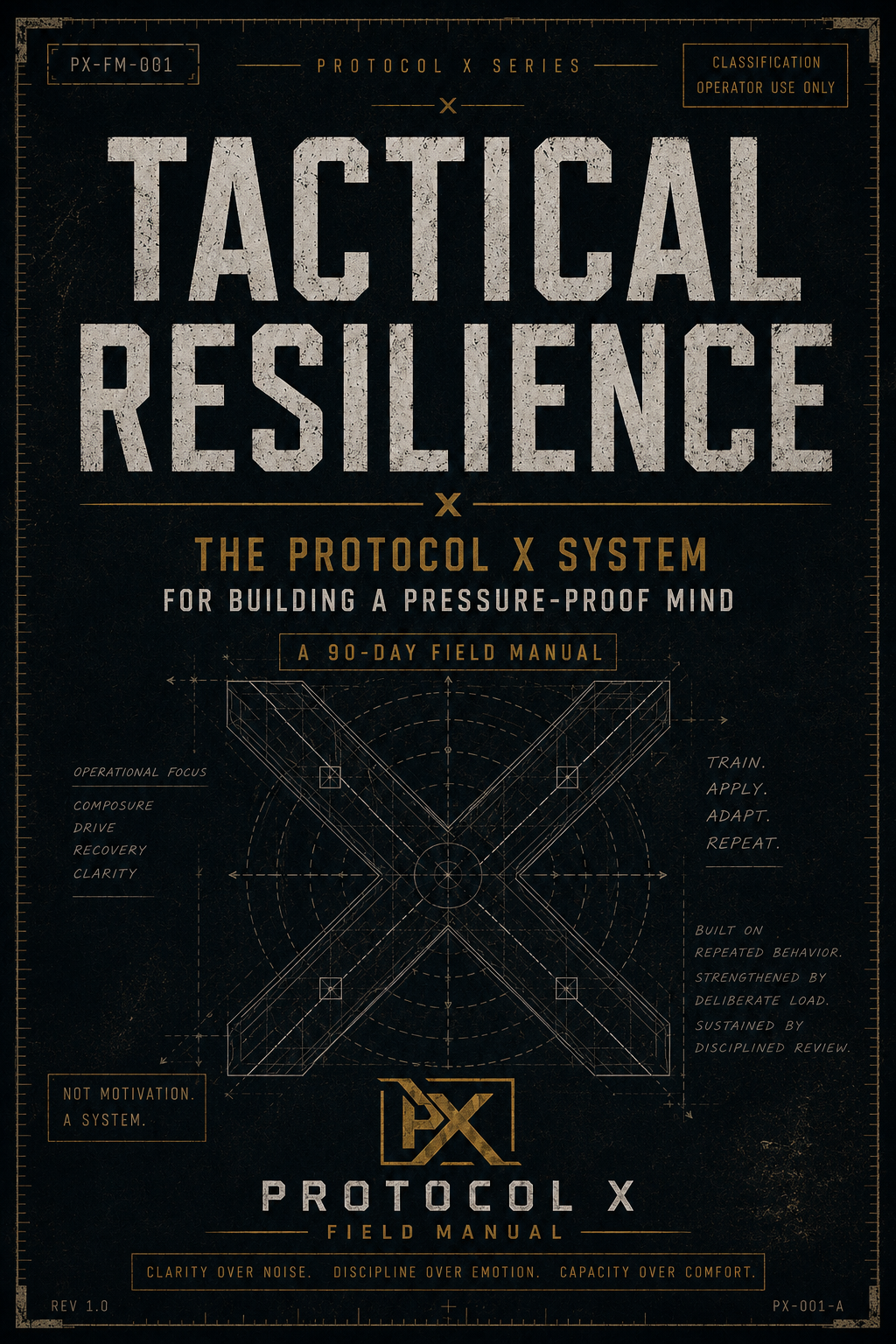
Tactical Resilience is a practical operating system for building clarity, composure, and consistency before pressure makes the decision for you.
When pressure rises, motivation becomes unreliable. Attention narrows. Emotion gets louder. Small gaps in structure become visible.
Competing signals flood attention until urgency starts making decisions.
Emotion replaces procedure. Speed increases, but response quality drops.
Small breaks in structure compound when there is no operating system to return to.
CLARITY OVER NOISE.
QUESTIONS BEFORE ANSWERS.
PRESSURE REVEALS THE STRENGTH OF YOUR SYSTEM.
The ADA Protocol is a repeatable decision loop for maintaining clarity and direction when it matters most.
Read the terrain. Identify variables. Separate signal from noise before pressure narrows the field of view.
Doctrine: Clarity over noise.Choose the next responsible action with clarity, not certainty. The question is not what feels urgent — the question is what moves the mission.
Method: Questions before answers.Execute with precision. Observe feedback. Refuse drift. Action creates the next read of the environment.
Outcome: Composure that can be trained.Return to assessment. The goal is not perfect decisions — the goal is consistent decision-making under pressure. The loop is the protocol.
Protocol: Systems outperform motivation. PREVIEW THE FRAMEWORK →One mission. Three priorities. One review. Repeat.
Define the direction before the day defines it for you.
Choose the three actions that move the mission forward.
Close the loop. Learn from the day. Reset the system.
A tactical worksheet extracted from Tactical Resilience. Use it to establish direction, action, and review before pressure makes the decision for you.
Tactical Resilience turns doctrine into repeatable practice: audit the baseline, install daily structure, regain composure, override bad signals, and review the cycle.
Map current pressure points, system gaps, and the conditions that degrade performance.
Install a short daily framework that creates direction, momentum, and disciplined review.
Use a repeatable sequence to respond instead of react when pressure demands speed.
Interrupt unhelpful patterns before they gain control and redirect behavior toward the mission.
Turn experience into structured learning through after-action review, calibration, and repetition.
Tactical Resilience